

Use case · Transfusion medicine
A real-time dashboard that releases reserved blood units faster
German hospital · Transfusion medicine · peer-reviewed in Transfusion Medicine (2025)
Result
Real time
detection of blood units reserved for patients who no longer need them
Units become available again faster. [Measured effect, e.g. units released per month, TBC from the paper]
- Transfusion medicine
- Hospital
- German hospital
- Data used
- EHR and LIS, harmonised in FHIR
- Technology
- Direct SQL queries in real time, visualised in Grafana
- Platform layers
- Data foundation and real-time dashboard
- Publication
- Transfusion Medicine (2025)
How it works
From a status change to a released unit
Unit reserved
A blood product is reserved for a patient in the LIS.
Patient status changes
The EHR records discharge, transfer or death.
Dashboard flags it
SQL on harmonised FHIR data detects the mismatch in real time.
Unit released
The blood bank returns the unit to stock.
The problem
Blood products stay reserved for patients who have been discharged, transferred or have died, because reservation and patient status live in separate systems. Scarce units are blocked longer than needed.
What was implemented
EHR and LIS data harmonised in FHIR on the Firemetrics data foundation. Direct SQL queries run in real time and feed a Grafana dashboard for the blood bank.
The result
Reserved units for patients who no longer need them are detected automatically and become available again faster. The work was peer-reviewed and published in Transfusion Medicine (2025).
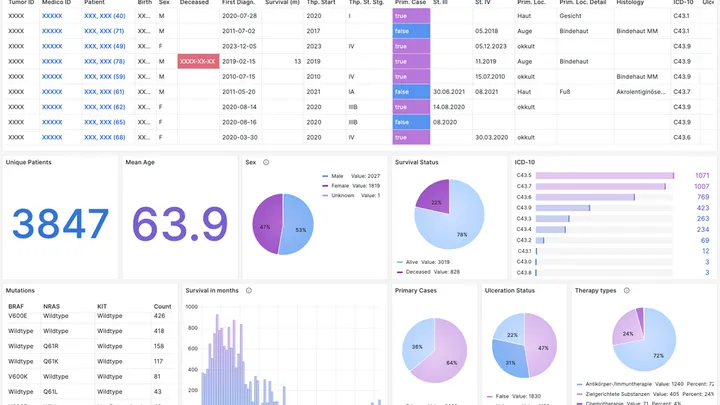
Real screenshot: blood products dashboard in Grafana, anonymised 1 2
- Transfusion Medicine, 2025 · authors and DOI
- Read the paper
Use cases
More use cases
All use cases
Which scarce resource is blocked in your hospital?
We show you how the same approach would run on your data.